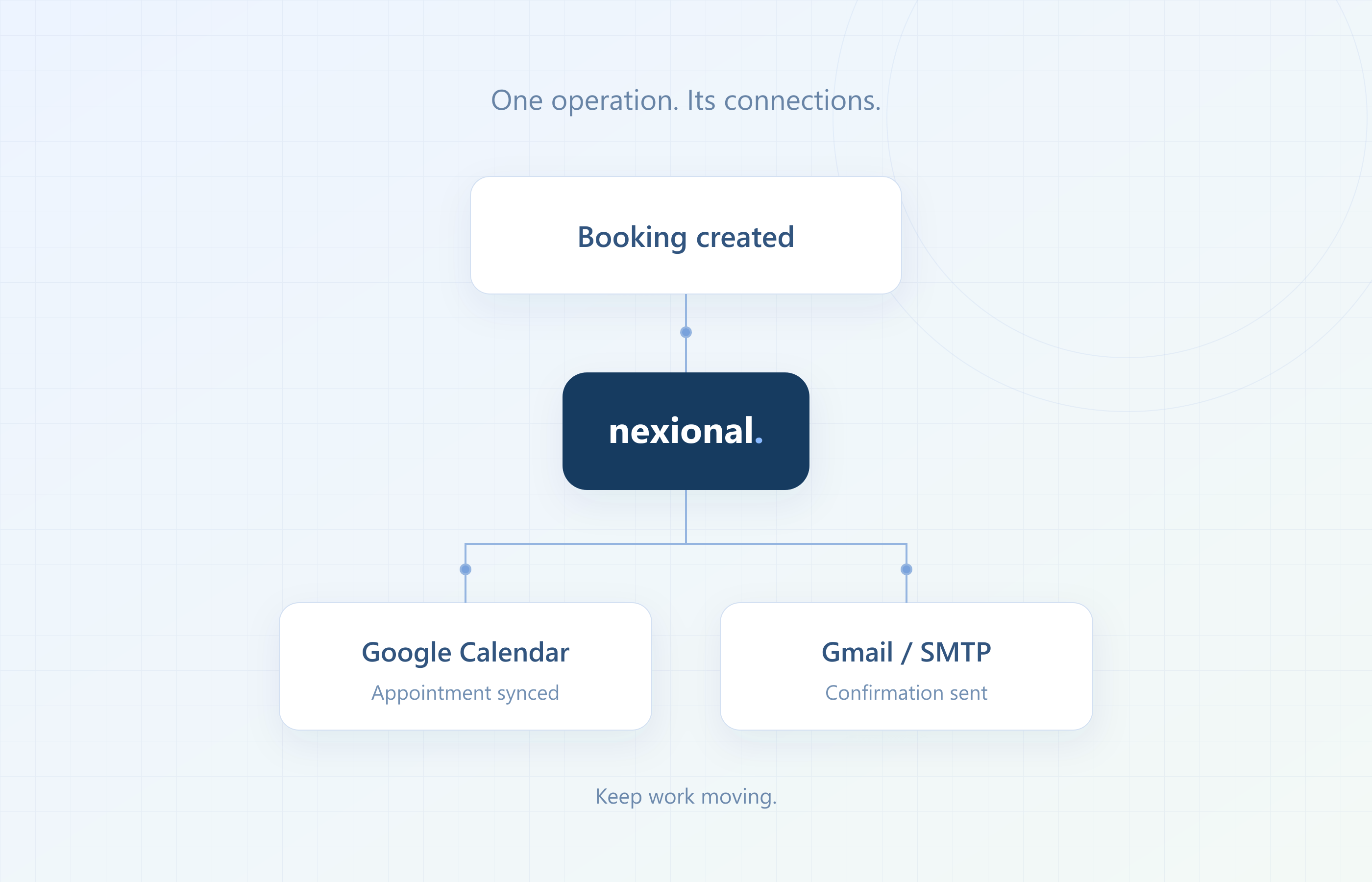

Automating a task is not the same as designing a real operation
There is a lot of excitement around AI agents, intelligent automations and tools that connect conversations, databases, APIs and actions. On paper, it sounds powerful. In practice, the problem is often not the technology itself, but the fact that businesses try to automate processes they have not clearly defined.
If it is not clear what the AI can answer, which data is reliable, which actions it may execute, when a person should step in or what must be recorded, automation does not solve the problem. In many cases, it only makes the problem faster and harder to review.
The real value is not having more automations. It is having more control over how the operation works.
The risk of building layers without control
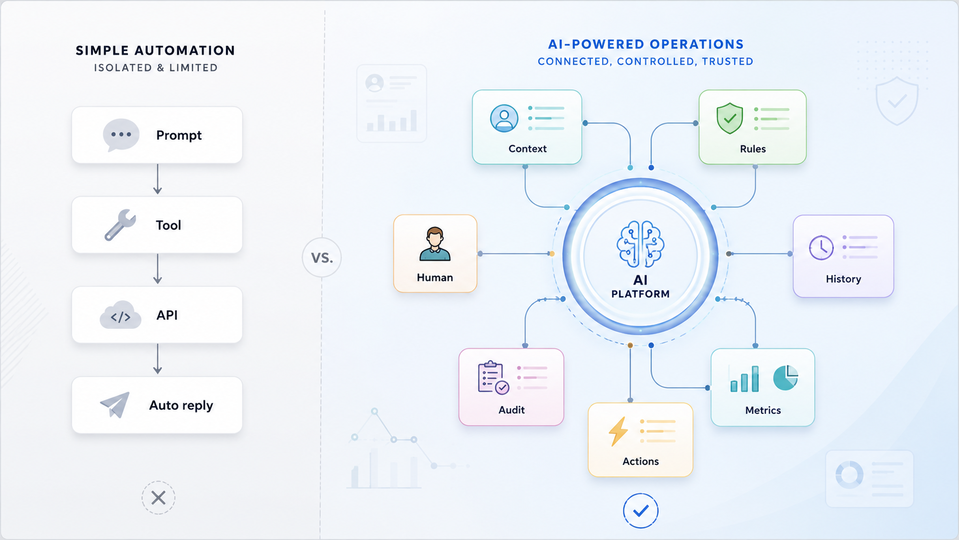
Many systems are presented as “agents”, but internally they are simply a stack of connected parts: a prompt, an automation tool, an API, a generated answer and a final action.
When everything works, it feels impressive. But when something fails, the important questions appear: why did it answer that, where did the information come from, was the action recorded, can a person review the case, and is there any way to measure whether the system is actually working well?
That is the problem with many quick AI setups. Not because the tools are bad, but because connecting pieces is treated as if it were the same as designing an operation.
A useful tool is not the same as a solved business process
Tools such as Make or n8n can be very useful for connecting systems, automating repetitive tasks or building internal flows. The mistake is assuming that an automation tool is the same as a complete business operation.
An automation can move data, send a message or trigger an action. A real operation needs more than that:
- knowing who the customer is,
- understanding the conversation context,
- applying business rules,
- recording what matters,
- handing off to a person when needed,
- and measuring whether the process is working.
An agent may answer, but that does not mean it serves well
This becomes very clear in customer service. Answering a question is not the same as serving a person properly.
To do that well, the business needs to know which channel the person came from, whether they contacted before, what was already answered, whether there is an open issue, whether a human should take over and whether a business rule applies.
Without that context, AI may sound convincing while still operating poorly. It may repeat information, lose the thread or execute something it should not.
What a business should require before automating
Before talking about autonomous agents or smart workflows, a business should have some core foundations in place:
- a reliable source of information,
- centralized channels,
- customer history,
- configurable business rules,
- traceability of conversations and actions,
- human handoff,
- internal notifications,
- and metrics to evaluate results.
These questions are less flashy than the usual AI pitch, but they are what really determine whether automation will help or simply create more noise.
How we approach it at Nexional
At Nexional, we do not see AI as a loose layer on top of chat. We see it as part of a broader operation.
That is why the starting point is not “let’s add an agent”, but understanding what the business needs to control: which channels it receives, which questions repeat, which processes can be automated, when AI should stop, when a person should step in and what needs to be recorded.
That difference matters. A business does not need a black box acting on its own. It needs an operation where AI has a useful, clear and controlled role.
Conclusion
AI can create enormous value, but not by adding more layers or connecting more tools for the sake of it. Its value appears when it becomes part of a well-designed operation with context, rules, traceability and human control.
Automating a task is easy. Designing an operation that really works is what makes the difference.